
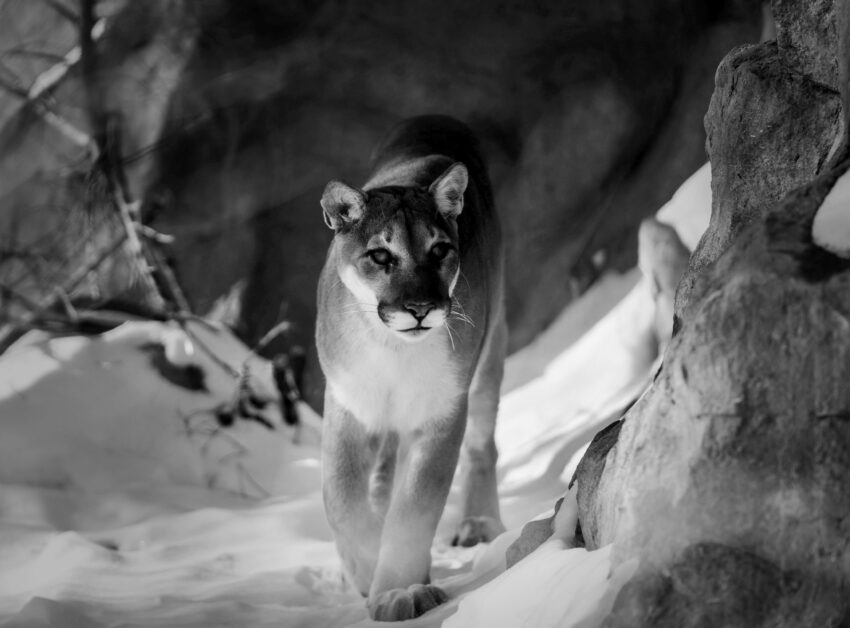
A Large Black Feline In The Backyard:
One night in the Spring of 2025, a West Virginia resident who we will call “James W.” was going to feed the family dog, guided through the dark only by a headlamp. As he approached the metal-gated fence enclosure or “dog lot,” he suddenly saw a pair of two bright orange eyes behind the structure.
When he looked over in the direction of the eyes, he quickly glimpsed a large dark animal on four legs, larger than a dog, which he described as looking like a mountain lion but black in coloration, about roughly 7ft in length. He said the animal quickly took off and ran out of sight in the darkness with its back legs moving forward first and unmistakably feline movements. A distant member of the family also supposedly saw a large black wild cat in the area over a decade previously.
In December of 2025, after the midnight hour had passed and turned December 7th into December 8th, around roughly 3AM, a strange shrieking sound could be heard from that same backyard by another resident of the home, his daughter, whom we’ll call “Amy W.”
It reportedly sounded like a woman screaming outdoors, which then caused the family dog to go crazy, barking loudly and repeatedly. Looking out the window, the resident saw only a sea of black, and attempting to shine a light didn’t help her to see anything. The screaming sound was heard only twice and ceased after the dog barking.
In the morning, Amy then told her father, who reasoned that what she heard was likely the sound of a mountain lion like the one he claimed to have seen in the backyard. Mountain lion vocalizations are often described as similar to a woman screaming or shrieking. The residents decided to set out a trail camera in hopes of capturing footage of the mysterious large black cat. This story was then conveyed directly to Appalachian Oddity with permission to publish.
A Panther Crossing At The Fishing Pier And More:
Over a decade ago, my sister’s friend was reportedly driving one night and witnessed a very large black cat she described as a “black panther” cross the road in front of a small fishing pier in Kanawha County, West Virginia. She told my sister, and my sister told me.
Oddly, the same fishing pier was home to another local folklore legend, a ghost tale about a “woman in white” supposedly seen roaming around the area. How strange that one location, a fishing pier overlooking the creek, would have two anomalous happenings reported, with one being ghostly and the other seeming much more zoological.
The image stuck with me. Just imagine a black panther-like cat darting out in the road in front of your vehicle, illuminated in your car’s headlights, and watching as it slinks its way across the road and out of sight. What a moment that would be. How would that effect you, and how you felt about driving at night afterwards if you saw that?
Ask someone from Appalachia if they’ve seen a sasquatch or a Flying Saucer, most often they’ll say no, but sometimes they’ll say yes. Ask someone from Appalachia if they’ve seen a mountain lion or a black panther, and you’ll be surprised at how often they say yes, considering they’re not supposed to exist here.
My own mother actually claimed to have witnessed a large mystery cat as well while driving through a different area of Kanawha County, West Virginia. The year was roughly 1993, she was alone in the car driving, when she supposedly saw what looked like a large black panther sat by the roadside in broad daylight. The large black cat reportedly had a long tail, bluish black fur, and was watching cars go by.
Official Status of Mountain Lions and The Department of Natural Resources:
According to West Virginia’s Department of Natural Resources (DNR), there are no mountain lions in West Virginia. They were officially declared extinct and removed from the endangered species list in 2018 by the U.S. Fish and Wildlife Service (USFWS) despite persistent reported sightings. They were first officially added to the endangered species list back in 1973, when the federal Endangered Species Act was first passed, before their eventual removal due to lack of physical evidence, which began as a lengthy process in 2011.
The eastern mountain lion or cougar, a subspecies previously native to the area, was allegedly wiped out in the Appalachian region by European colonists. The last officially reported killing of a mountain lion in West Virginia was in Pocahontas County in 1887. Legends and locals say otherwise, but it can’t be proven.
The last officially confirmed record of eastern cougars in West Virginia was possible tracks found in 1936 in the vicinity of Kennison Mountain, Pocahontas County, by workers from the National Museum of Natural History. Beyond that, nothing is officially recognized.
In 1938, the last verified eastern cougar was shot and killed by a trapper in Somerset County, Maine. This, of course, wasn’t in Appalachia, but it’s deemed the last confirmed kill of an eastern cougar in the United States and allegedly marks the subspecies’ extinction.
In early April 1976, a male mountain lion was officially shot and killed on Droop Mountain in Pocahontas County, West Virginia, by a farmer protecting his livestock, though it was then determined by officials to be a western cougar, not a native eastern one, likely released from captivity and possibly from the exotic pet trade. Another female cougar missing part of her tail was found nearby, captured by DNR, and removed to the French Creek Wildlife Center. Officials often attribute any sighting of a mountain lion or mystery large cat to escaped captives of the western cougars or other exotic pets, and this is a documented example of that actually occurring.
In June of 2011, a male mountain lion was hit by a car and killed in Connecticut. It was then examined via necropsy and confirmed by officials that the wild cougar came from the Black Hills of South Dakota and had traveled 15,000 miles to the state of Connecticut. This became the longest documented wandering of a western cougar eastward. It was the first confirmed sighting of a mountain lion in Connecticut in over a hundred years. This find of course, didn’t take place in Appalachia, but it proves that this behavior, while deemed abnormal, is possible. This is evidence that cougars can travel such distances, even if there is currently no evidence of a native population.
Supposed encounters with mountain lions and black panthers have become a common part of West Virginia folklore. Several news articles have been written about the seeming controversy between the many local reported witnesses and the DNR, stating that they don’t exist. West Virginian old-timers and avid outdoorsmen are adamant in what they say they’ve seen and continue to attest that they do indeed exist. For some, it’s become a form of folkloric “conventional wisdom” that mountain lions are perhaps rare and unacknowledged but still there.
Other Recorded Folkloric Sightings:
In chapter one of Michael Newton’s Strange West Virginia Monsters (2015), entitled “Phantom Felids,” the author documents reported cases of mysterious big cats in the Mountain State. He records a Calhoun Chronicle article in which supposed witness Nat Depue, of Creston, WV, alleged to have encountered a huge wild cat in January of 1911 that attacked the neck of his horse Nattie before being kicked off. The article goes on to list a teen girl in the late 1910’s reportedly being menaced by a cougar that her older brothers then shot and killed with their rifles.
He continues to chronologically list mountain lion sightings in West Virginia, spanning over a hundred years from 1911 to 2012. He lists Ralph Larock as having seen a cougar by the roadside on Frog Eye Road in Hampshire County, West Virginia on January 8th 1977, as well as David Kurtz as sighting a mountain lion on a coal hauling road in Randolph County on May 16th 1977, and Don Barger and his wife reportedly seeing one on the 4th of July 1977 near the Point Mountain fire tower in Webster County. He goes on to list more and more cougar sightings from throughout the 70s, 80, 90s, 2000s, and 2010s.
In 1983, John Lutz, of Maysville, West Virginia, founded the Eastern Puma Research Network (EPRN) to investigate and catalog reported sightings of the supposed eastern mountain lion. John Lutz is also known for investigating the West Virginia “Apple Devils” sightings in 1960, which were supposedly dark, hairy, sasquatch-like creatures reported to steal apples from apple orchards in Marlinton, West Virginia.
Also in 1983, Todd Lester, a third-generation West Virginia coal miner, reportedly sighted a mountain lion while hunting in southern West Virginia, but was disbelieved by DNR, leading to him establishing his own “Eastern Cougar Network (ECN)” in 1998 to document reported sightings. It was later renamed the “Cougar Rewilding Foundation (CRF)” and is reportedly based around Hanover, West Virginia.
Another of the many supposed mountain lion sightings in West Virginia, listed in Michael Newton’s book, was the story of Cheney Allman, who reportedly saw a cougar climbing along McGowan Mountain when being driven by her boyfriend near Parsons in Tucker County, West Virginia. She said they both had a clear view of the very large cat, which he commented was a beautiful animal.
In March of 2020, Aleksandar Petakov, working with the team of Small Town Monsters, released an hour-long documentary entitled “Lions of The East,” which documented supposed sightings of mountain lions in the New England area and the researchers who study them. In 2022, the excellent documentary was then posted on the Small Town Monsters YouTube page for viewers to watch for free.
Black Mystery Cats:
In the second half of the chapter in his book, author Michael Newton delves into the mystery of the large black mystery cats or “black panther” like sightings. An example of this being Jesse Romanello, who reportedly witnessed a large black animal with a long, slim tail on June 15th 1949 at 11:45 PM, which then fled into the woods.
Newton writes: “While bow hunting in 1985, James Bergstrom and his brother met ‘a large, completely black mountain lion’ on a logging trail near Old Stony Dam in Grant County, [West Virginia.] The cat’s appearance shocked them and spooked a deer they were stalking.”
According to author Michael Newton, in the late 1980’s a man identified as “Tom H.” reportedly witnessed a “cougar-sized black cat” laying across a pile of wood by the roadside and correspondent “Carla” claimed that her father, two brothers, and several friends supposedly saw a “panther” in January of 1998 while rabbit hunting in Greenbrier County, West Virginia.
In October 2001, researcher John Lutz and his wife Linda declared they had collected seventy-six reports of supposed black panther sightings in West Virginia from July 1983 to December 2000. The question is: Why are so many mystery cat sightings of large black cats?
Surely, that would be a much more rare biological attribute if these are indeed real felines.
The term “black panther” is an umbrella term for both melanistic leopards in Africa and Asia, as well as melanistic jaguars, which are mostly in South America and Mexico, and very rarely in certain areas of the United States, very far off from Appalachia. Sometimes the term “black panther” is used in anomalous reports in the U.S. to describe what the mystery large black cats supposedly looked like.
Saying you’ve seen a “black panther” in the eastern United States is akin to saying a zebra or giraffe walked out in front of your car. Thus, these supposed sightings could be said to be of “black panther-like” large cats, but even then, there is no native biological animal to exactly match that description.
What then could explain these types of cats?
Misidentification Theories:
There are, of course, many ways of explaining all of this as simple misidentification, which the witnesses naturally reject. Some have posited melanistic Bobcats as an explanation, but those more often have dotted black or patterned black fur, and have a very distinctive shape or outline, a short tail, and are much smaller, up to about 4ft in length. They do have yellow or golden eyeshine though, which I suppose can be seen as similar, though even then they are smaller. Bobcats just don’t really resemble cougars.
Another example being a mammal in the weasel family called a “Fisher” or “Fisher Cat,” which isn’t a cat but can appear feline-like. Again, these animals can be about 4ft in length, which is much smaller than supposed witnesses claim. They have green eyeshine, and also just don’t resemble a black panther-like cat when seen clearly.
While these may explain low-light sightings at distances in which the size can be very misjudged, it doesn’t account for the more clear-cut sightings and certainly can’t explain away a century of folkloric storytelling, which can come from many different motivations beyond just misidentification. Things are never that simple or reductive.
Are There Really Mountain Lions or Large Black Cats in West Virginia?:
Is it possible that an elusive remnant of the eastern mountain lions has actually survived? Are they perhaps more resilient than previously thought? Could they have even somehow melanated to a black coloration for nocturnal stealth beyond our current accepted knowledge? Or is it possible that mountain lions or large cats from other regions have somehow migrated or wandered off to Appalachia?
Perhaps these cougars are traveling due to habitat destruction in search of new territory. The white tail deer population, the cougar’s natural prey, did see a rebound and then a boom in the mid 20th century in the eastern United States. Could the cougars reclaim parts of the east, if they truly left that is? Is it possible that there is a large enough cougar population in the east to account for many of the folkloric sightings, or is that simply not scientifically plausible?
Surely, it’s a bit less far-fetched than a sasquatch or a flying saucer. It is, after all, a known species, just in a different place than usual. Though in some cases, a different color, one that is allegedly impossible.
A melanistic mountain lion is currently considered scientifically impossible as they reportedly lack the specific genetic mutation that exists in jaguars and leopards for the black coloration. There has never been a proven or official case of a melanistic mountain lion being killed or captured.
Possible Folklore Meanings:
If the stories of mountain lions are just folkloric with no reality there, what could be the meaning behind them? Is it motivated by the same fear-mongering about cougar attacks on people and livestock that rendered the eastern cougars officially extinct to begin with? Is it motivated by telling the brave tale of narrowly escaping unseen threats of the wilderness? Or perhaps by a recognition of what should be there?
Looking around, you could imagine mountain lions thriving here as they once did. How could the Mountain State not have mountain lions? Are we simply surrounded by the ghost cats of our troubled past? Perhaps we sense that something is missing, and some have found that imagining them back is the perfect chilling yet exciting campfire tale with an added strange seeming plausibility to the average person.
Conclusions And A Worldwide Phenomenon:
With thousands of trail cameras going up each year across the state of West Virginia by avid hunters of deer, bear, and raccoons, it would seem likely that at least one would capture these cougars or mystery cats on camera if they existed. Though often times hikers stick to trails and hunters stick to relatively human accessible areas rather than the very deep woodlands. Is it possible that such a large and nearly unmistakable animal could go so undetected beyond just sightings?
Are locals with evidence just not coming forward or being too quickly dismissed as cranks or kooks by understandably skeptical or uninterested officials?
In over two decades of monitoring, West Virginia wildlife officials have allegedly found no evidence that they deem credible, such as clear photos, tracks, scat, or physical remains. If the eastern cougar were proven or recognized as existing, it would need to be declared endangered and protected. This would also likely cause a bit of a panic among people who could become frightened of the outdoors or fear for public safety from the very rare potential cougar attacks. Surely, those issues aren’t too much for us to afford or handle. The public lives alongside wildlife like bears currently in the eastern United States, as well as cougars in the western regions. If they verifiably existed, there would be no reason for them not to be declared.
Perhaps the mystery goes deeper than just that.
Charles Fort, an early recorder of anomalous phenomena from whom “Fortean” researchers are named, documented what he called “out of place animals” all over the world back in the 1920’s and 30’s. Could these sightings somehow be a part of a paranormal phenomenon?
Later researchers of anomalous phenomena, such as monster folklore collectors, have used various terms like “Phantom Cats,” “Phantom Panthers,” or “Mystery Big Cats” to describe such big cat anomalies, which are also strangely a worldwide thing.
What could account for such stories being told all around the world?
The term “Phantom Panther” was reportedly coined by author Loren Coleman in his FATE magazine article “Phantom Panthers On The Prowl” in November 1977. He purportedly took inspiration for the term from the book title “Ghost of North America: The Story of the Eastern Panther (1959)” by Bruce S. Wright. Fortean author John Keel had used the similar term “Phantom Cats” prior in Chapter 3 of his book “Strange Creatures From Time And Space” in 1970.
The term “Alien Big Cats (ABC)” was reportedly coined by Janet Bord, who authored the book “Alien Animals (1980)” with her husband Colin Bord. The term was then adopted and first used as an acronym by Fortean Times editor Bob Rickard in an article entitled “Once More With Felines” in summer 1985 (FT Issue #44.) The word alien here, of course meaning simply foreign or unfamiliar to us.
There are also reported sightings of things like “Phantom Kangaroos” in places where kangaroos aren’t native, or reports of long extinct “Living Dinosaurs.” Reports of strange people dressed as clowns in unexpected locations are even called “Phantom Clown” sightings, as reportedly coined by author Loren Coleman once again in FATE magazine’s March 1982 issue. Reports of mystery men like the infamous dark-suited “Men In Black” are sometimes labeled “Phantom Strangers” by online sleuths and Forteans.
Not all phantoms or phantasms are ghosts, it seems; sometimes a phantom could be something that disappears without a trace as if it were never there to begin with, and sometimes a phantom can be something that perhaps shouldn’t exist at all or something that logically can’t exist and yet is there. A phantom simply defies explanation and boldly mocks your perceived reality as it supersedes it. The impossible, the condemned, yet existent and tauntingly laughing all the while.
Sometimes the question is much more important than the answer.
Are such things in West Virginia? Perhaps only with a Cheshire smile.
——————————————————————————————————————
UPDATE: The West Virginia resident James W., from the above sighting that began this article, after learning about the backyard sounds heard by his daughter Amy W., then put out a trail cam by the dog lot on the evening of December 9th 2025, and kept it there taking snapshots of any movement until January 3rd 2026.
He also left out some freezer-burned meat he had near the spot where the animal was sighted, and in view of the trail camera, in hopes of attracting the animal. No photos of any large mystery cat or mountain lion were taken by the trail cam. The mystery, as always, persists.
——————————————————————————————————————
Further Reading / Research:
Strange West Virginia Monsters (2015) by Michael Newton
Alien Animals (1980) by Janet And Colin Bord
Lions of The East (2020) Documentary by Aleksandar Petakov and Small Town Monsters
News Articles:
“Cougar Sightings Persist” By MetroNews, January 2nd 2008.
(Original Link:) https://wvmetronews.com/2008/01/02/cougar-sightings-persist/
(Archived Link:) https://web.archive.org/web/20260110114428/https://wvmetronews.com/2008/01/02/cougar-sightings-persist/
“I Swear it was a Black Panther…” By MetroNews, June 23rd 2009.
(Original Link:) https://wvmetronews.com/2009/06/23/i-swear-it-was-a-black-panther/
(Archived Link:) https://web.archive.org/web/20220319032902/https://wvmetronews.com/2009/06/23/i-swear-it-was-a-black-panther/
“Are there mountain lions in WV? DNR says no, locals say yes” By Amanda Barber of 12WBOY, June 29th 2022.
(Original Link:) https://www.wboy.com/news/west-virginia/are-there-mountain-lions-in-wv-dnr-says-no-locals-say-yes/
(Archived Link:) https://web.archive.org/web/20220701221742/https://www.wboy.com/news/west-virginia/are-there-mountain-lions-in-wv-dnr-says-no-locals-say-yes/
“Are Mountain Lions Really in West Virginia? Experts Say No” By WV News, June 3rd 2025.
(Original Link:) https://www.wvnews.com/news/wvnews/are-mountain-lions-really-in-west-virginia-experts-say-no/article_3d28210f-53d5-4dce-8356-42b54801bec3.html
(Archived Link:) https://web.archive.org/web/20250604103129/https://www.wvnews.com/news/wvnews/are-mountain-lions-really-in-west-virginia-experts-say-no/article_3d28210f-53d5-4dce-8356-42b54801bec3.html